

How Seniors Can Start a Safe Weekly Fitness Routine
If you have been thinking about getting fitter but aren’t sure where to begin, this guide is for you. You don’t need a gym, special clothes, or experience. You need a simple plan that respects your body and fits into an ordinary week — groceries, grandchildren, and all.
Most older beginners fail for one reason: they start too hard. One exhausting workout leaves you sore and discouraged. The question of how seniors can start a safe weekly fitness routine has a simpler answer than most people expect — a little gentle movement most days, rest days built in, and small increases only when your body says it is ready. Here is one clear week you could start this Monday, plus simple rules for adjusting it up or down.
One important note first: check with your doctor before starting any new exercise routine. A quick conversation confirms which activities are safe for you, especially if you take medication or live with a condition that affects how you move.
Key Takeaways
- Talk to your doctor before starting any new exercise routine, especially with a health condition or regular medication.
- A safe senior week rests on three building blocks: gentle cardio, light strength, and balance and flexibility.
- Twenty minutes of easy movement on most days beats one exhausting workout a week.
- Rest days are part of the plan, not a failure — schedule them like the active days.
- Repeat the same easy week two or three times before adding minutes or difficulty.
- Soreness that fades in a day or two is normal; sharp pain, dizziness, or chest discomfort mean stop and rest.
- Consistency over intensity — showing up gently, week after week, is what builds strength and stamina.

Building Block 1: Gentle Cardio
Cardio simply means movement that raises your heartbeat a little — you feel warm and your breathing deepens, but you can still hold a conversation. For most seniors, walking is the perfect choice. It is free, starts at your front door, and you control the pace.
Begin with a ten to fifteen-minute walk on flat ground. If walking bothers your knees or hips, try gentle swimming, stationary cycling, or marching in place at home while holding a sturdy chair. The activity matters less than the feeling: easy, steady, sustainable.
Use the “talk test” — if you can speak in full sentences without gasping, you are in the right zone. Many beginners walk too fast because going slowly feels silly. Slow and steady is exactly how stamina gets built.
Building Block 2: Light Strength
After fifty, we gradually lose muscle unless we work to keep it — and that muscle keeps you independent. It carries the shopping bags, lifts you from a chair, and steadies you when you stumble. Light strength work twice a week is enough to start reversing that loss.
No weights needed at first; your body weight is plenty. Try five simple moves, eight to ten repetitions each: chair squats (sit down and stand up slowly), wall push-ups, seated leg lifts, standing calf raises holding a countertop, and water-bottle bicep curls. One set of each is enough.
Move slowly and never hold your breath — exhale on the effort, inhale as you relax. You should feel muscles working, not joints protesting. Do these on two non-consecutive days, because muscles grow stronger during the rest between sessions.
Building Block 3: Balance and Flexibility
Falls are a real worry for older adults, and balance is a skill you can train. Stand behind a sturdy chair, lift one foot a few inches off the floor, and hold for ten seconds, then switch sides. Walk heel-to-toe along a hallway line. When these feel easy, hover your hands above the chair instead of gripping it.
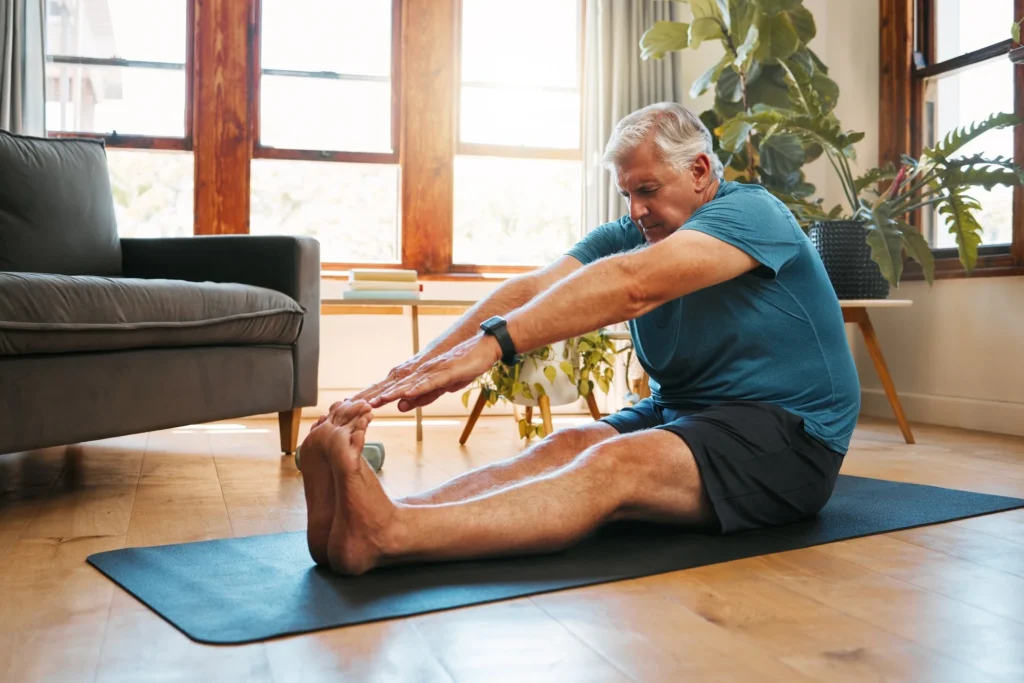
Flexibility keeps daily movements comfortable — reaching a shelf, turning to look behind you, tying a shoe. Stretch gently after you are warm: shoulder rolls, a cross-body arm stretch, a seated neck turn to each side, a standing calf stretch, and a seated hamstring stretch. Hold each for fifteen seconds without bouncing; it should feel like a pleasant pull, never a sharp tug.
How to Arrange Your Week (With Rest Days Built In)
You do not need to exercise every day. Rest days do important work — they are when your body repairs and gets stronger. Skipping them is the fastest way for a beginner to get sore and quit. Here is the simple logic:
- Do cardio three days spread across the week — for example Monday, Wednesday, Friday. Start with fifteen minutes.
- Add two light strength sessions on non-cardio days — for example Tuesday and Saturday.
- Attach ten minutes of balance and stretching to the end of cardio days, when your body is warm.
- Keep at least two true rest days with no planned exercise. An easy stroll is fine if you feel like it.
- Don’t combine strength and cardio on the same day at first — that is a recipe for overdoing it.
- Write the plan on your calendar. A routine you can see is one you will actually follow.
That is five gently active days and two rest days. If five sounds like a lot, start with three active days and four rest days. You can always add a day later — you cannot undo an injury from doing too much too soon.
A Sample Week You Could Start Monday
Times are suggestions, not orders. If fifteen minutes is too much on day one, start with ten and add a minute or two each session.
| Day | Focus | Example Activity | Minutes |
|---|---|---|---|
| Monday | Cardio + balance | Comfortable walk, then standing balance practice | 15 + 10 |
| Tuesday | Light strength | Chair squats, wall push-ups, leg lifts, calf raises, curls | 15-20 |
| Wednesday | Cardio + stretching | Comfortable walk, then gentle full-body stretches | 15 + 10 |
| Thursday | Rest | No planned exercise | 0 |
| Friday | Cardio + balance | Comfortable walk, then standing balance practice | 15 + 10 |
| Saturday | Light strength | Chair squats, wall push-ups, leg lifts, calf raises, curls | 15-20 |
| Sunday | Rest | No planned exercise | 0 |
No session exceeds about twenty-five minutes, and that is deliberate. A short session you complete beats a long one you skip. Many people find it helps to move at the same time each day — after breakfast, say — so it becomes rhythm, not a daily decision.
How to Progress After Two or Three Weeks
Repeat the sample week two or three times before changing anything. Your joints and stamina are quietly adapting. When sessions start to feel easy, change only one thing at a time.
The simplest step is time: add five minutes to your walks, working toward twenty, then twenty-five. For strength, add a second set or slow each repetition down. For balance, hold positions a few seconds longer or lean on the chair less. Increase your total weekly effort by no more than about ten percent.
Keep a simple log — a tick on the calendar for each completed day. Looking back over a month of ticks is deeply motivating. If a session has felt easy for two weeks running, that is genuine progress, even if nothing else has visibly changed.
Signs You Should Rest or Stop
Mild soreness a day after strength work is normal and usually fades within forty-eight hours. But stop the session and rest if you feel sharp pain in a joint or muscle, dizziness, unusual shortness of breath, chest discomfort, a racing or irregular heartbeat, or nausea. Never push through these.
If chest discomfort, fainting, or severe pain occurs — or any warning sign repeats — contact your doctor promptly rather than simply resuming. Also respect slower signals: pain that worsens over several sessions, swelling that does not settle, or exhaustion lingering into the next day. Swap the offending exercise for a gentler one, take an extra rest day, and raise persistent problems with your doctor or a physiotherapist.
Frequently Asked Questions
Is walking really enough to count as exercise?
Yes — especially at the start. Walking raises your heart rate, strengthens your legs, improves balance, and lifts your mood, with no equipment at all. Later you can add minutes, gentle hills, or the strength and balance work from this plan. Never dismiss walking as “not real exercise” — it is the foundation of everything else.
What if I miss a day — should I double up the next day?
No. Just pick up where you left off. Doubling up to “make up” for a missed session is how beginners get injured. One missed day changes nothing; treat it as a rest day that moved.
How will I know I am actually progressing?
Watch for everyday wins: the stairs that used to wind you feel easier, you rise from a low chair without using your arms, your balance hold lasts longer. These are the victories that matter, because they keep you independent. Your log of completed sessions is proof, even on weeks when nothing feels different.
Do I need any equipment to start?
Only comfortable shoes and a sturdy chair. This plan uses bodyweight moves and water bottles as light weights. You might add resistance bands later, but that is a “later” purchase — be wary of anyone who says you need special gear to begin.
What if I have arthritis or another health condition?
Many people with common conditions exercise safely every day, but the right exercises depend on your situation — which is why the doctor check comes first. Describe your limitations honestly and ask which movements suit you. A condition usually means modifying the plan, not abandoning it.
Your Week, Your Pace
Starting a fitness routine after sixty is not about becoming an athlete. It is about staying the person who can carry the groceries, play on the floor with the grandchildren, and walk to the shops without thinking twice. That is worth fifteen minutes a day.
Begin this Monday if you can — any day works. Start gently, rest honestly, progress slowly. That is how seniors can start a safe weekly fitness routine and actually stick with it: not a perfect month, but one ordinary week at a time.