Low-Impact Workouts for Older Adults
There is a quiet kind of courage in lacing up your shoes and deciding to move a little more than you did yesterday. If you are in your sixties, seventies, or beyond — or you simply feel like your body asks for gentler treatment these days — you might wonder whether exercise is still worth the trouble when high-intensity classes and running groups seem built for someone else.
Here is the good news: you do not need to jump, pound, or push yourself to exhaustion to get real benefits from exercise. Your heart, your muscles, and your mood respond beautifully to movement that is kind to your joints. Walking a little farther each week, pedaling gently, or moving in water can strengthen your body in ways you will feel when you climb stairs or carry groceries.
This guide is for you if you are starting from the couch or coming back after a long break. Take what feels useful, leave the rest, and move at a pace that feels honest for your body today.
Key Takeaways
- Low-impact exercise keeps at least one foot on the ground at all times, so your joints absorb far less shock than with running or jumping.
- Check with your doctor before starting any new exercise routine, especially if you have a heart condition, balance problems, or are managing chronic pain.
- Walking, gentle stationary cycling, water-based movement, and dancing at home are all excellent joint-friendly cardio options for older adults.
- Aim for about 20 minutes of comfortable movement, three to five days a week, and build up gradually rather than all at once.
- Always warm up for a few minutes first and cool down slowly afterward — your joints will thank you.
- Low-impact does not mean low-benefit: consistent gentle movement improves heart health, strength, balance, and mood.
What “Low-Impact” Actually Means in Plain Words
Forget the fitness jargon. “Low-impact” simply describes any movement where your body avoids hard landings and sudden jolts. When you run, every step slams two to three times your body weight through your ankles, knees, and hips. When you walk, one foot stays on the ground at all times, and the shock traveling up your legs drops dramatically.
That is the whole idea. Low-impact exercise protects the cushioning in your joints while still asking your heart to work a little harder and your muscles to do their job. Think of it as the difference between hammering a nail and pressing a thumbtack into a board — both get something done, but one is far gentler on the hand holding the tool.
Joint-Friendly Cardio Options You Can Actually Enjoy
You do not need a gym membership to get moving. Here are four kinds of cardio that are kind to older joints — pick the one that sounds most like you.
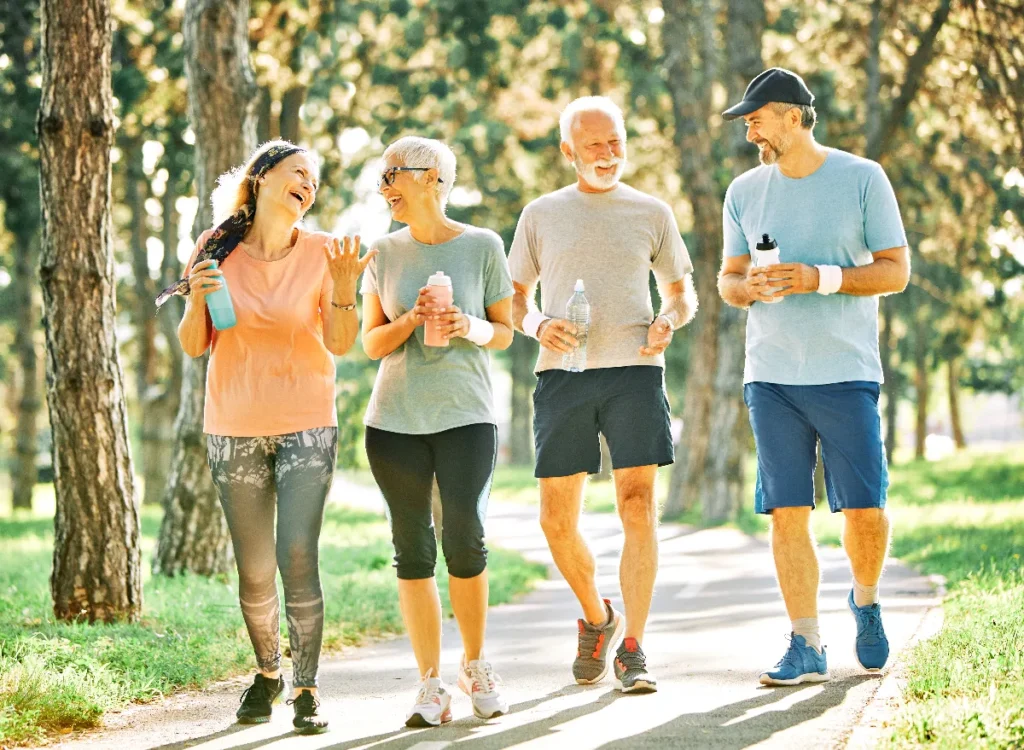
Walking. The simplest exercise ever invented, and still one of the best. Start with ten minutes around the block and add a few minutes each week. A supportive pair of shoes matters more than speed; aim for a pace where you can hold a conversation without gasping.
Gentle cycling on a stationary bike. Because the bike seat holds your body weight, your knees and hips do the pedaling without carrying you. Keep the resistance low, the seat high enough that your knees only bend slightly at the bottom of each stroke, and pedal at a steady, comfortable rhythm.
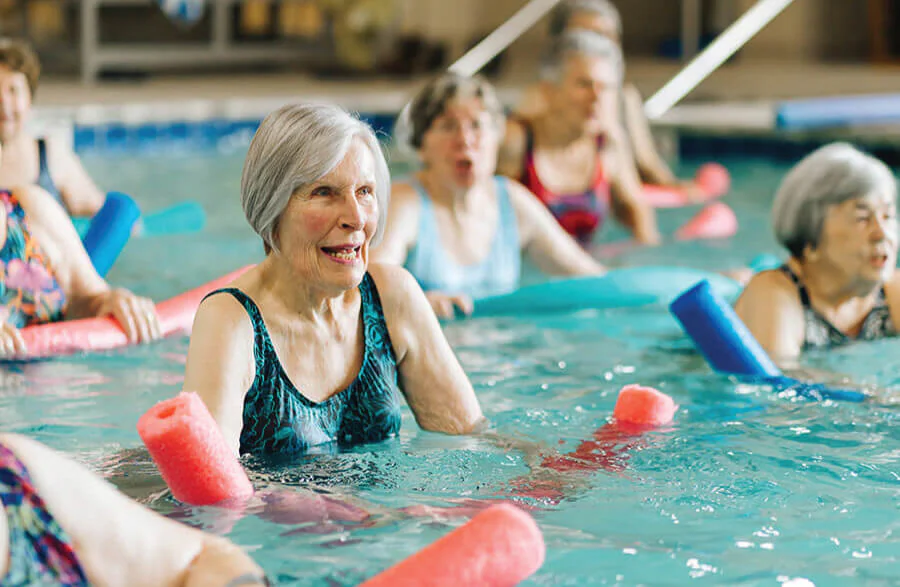
Water-based movement. If you have access to a pool, the water is one of the kindest places to exercise at any age. Walking laps in the shallow end, treading gently, or joining a seniors’ water class lets you work your heart and muscles while the water supports most of your weight. People with stiff joints often find they can move in the pool in ways that feel impossible on land.
Dancing at home. Put on music you love and move the way that feels good. Side steps, swaying, gentle knee lifts, and turning in place all count. Dancing sneaks in balance practice and leg strength without feeling like a workout. Nobody is watching, so there is no wrong way to do it.
Your Sample 20-Minute Low-Impact Session
This is a complete session you could try tomorrow morning. You need nothing but a sturdy chair nearby for balance, comfortable clothes, and a glass of water. Rest whenever you need to — pausing is part of the workout, not a failure.
- Warm-up (minutes 0–3): Stand behind your chair, fingertips resting lightly on the back, and march in place at an easy pace. Roll your shoulders a few times and take three slow, deep breaths.
- Step-touches (minutes 3–5): Step your right foot to the side, bring your left foot to meet it, then step left and meet it again. Add a gentle arm swing.
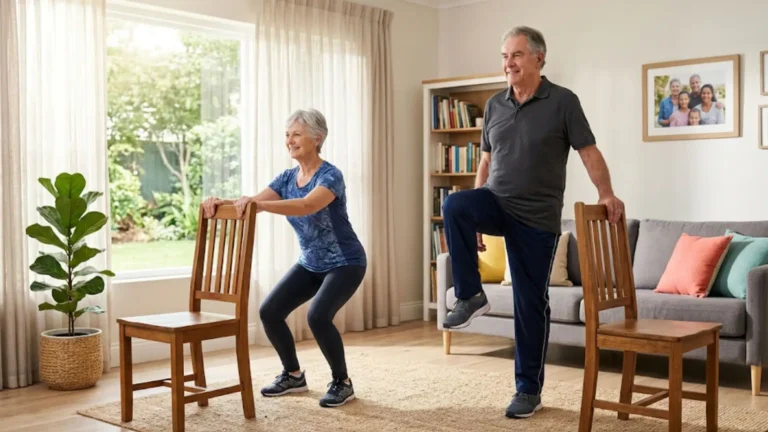
- Knee lifts (minutes 5–7): Holding the chair if you like, lift one knee to a comfortable height, lower it, then lift the other. Alternate at a steady rhythm.
- Gentle march with arm circles (minutes 7–10): March in place while making small circles with your arms, first forward, then backward. You should feel your heart beating a little faster — a brisk walk feeling, not a sprint.
- Side steps with a reach (minutes 10–13): Step to the right and reach both arms up at a slight angle. Step back to center, then step left. Keep the reach comfortable for your shoulders.
- Slow walking pace recovery (minutes 13–15): Walk in place or stroll around the room at a relaxed pace. Let your breathing settle back toward normal and shake out your arms and legs.
- Standing leg curls (minutes 15–17): Behind your chair, slowly bend one knee to bring your heel toward your bottom, then lower it. Alternate legs. This wakes up the muscles at the back of your thighs.
- Cool-down stretch (minutes 17–20): Calf stretch against a wall, a gentle quad stretch holding the chair, and shoulder rolls. Finish with three deep breaths, in through your nose and out through your mouth.
If twenty minutes feels like too much at first, do ten and call it a win. Repeat this session week after week, and the warm-up that once left you winded will start feeling like nothing at all. That is progress, and you earned it.
How to Warm Up and Cool Down Gently
A warm-up is simply a polite introduction between your body and the workout. Spend three to five minutes doing a slower, smaller version of what you plan to do: easy marching, shoulder rolls, neck tilts, and gentle ankle circles. You are giving your muscles notice and your joints time to loosen their morning stiffness.
Your cool-down is the goodnight. Spend another three to five minutes moving slowly and stretching the muscles you just used. Hold each stretch for about twenty seconds — long enough to feel a gentle pull, never a sharp tug. Let your heart rate drift back down as you breathe deeply. This gradual ending reduces next-day soreness.
One more practical tip: dress in layers and keep water within reach. Older bodies adjust to temperature a little more slowly, and staying hydrated matters more than most people realize.
High-Impact Moves vs. Their Low-Impact Alternatives
| High-Impact Move | Low-Impact Alternative | Why It Helps |
|---|---|---|
| Running or jogging | Brisk walking | One foot stays grounded, cutting joint shock while still raising your heart rate. |
| Jumping jacks | Step-touches with arm raises | The same rhythmic full-body motion with no landing jolt on knees and ankles. |
| Burpees | Wall push-ups plus gentle marching | Builds strength and gets you breathing harder without dropping to the floor. |
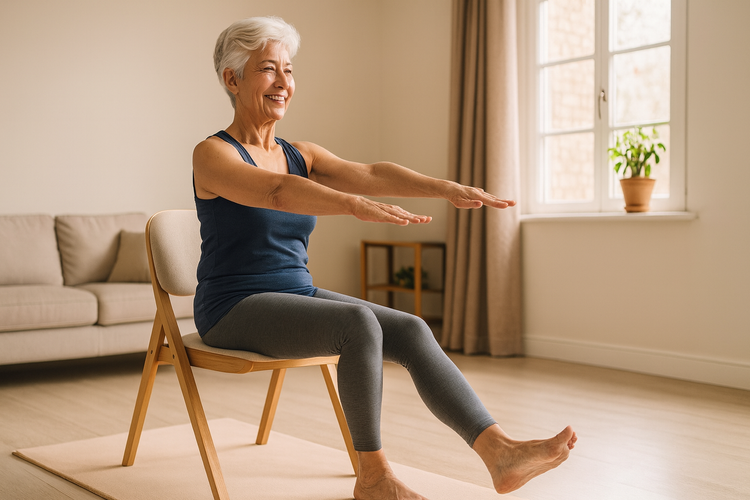
| Jump squats | Chair-assisted sit-to-stand | Strengthens your legs for real life — standing up — without pounding your hips. |
| High-knee running | Standing knee lifts holding a chair | Works the same hip and core muscles at a speed your joints can handle. |
| Mountain climbers | Step-back lunges or slow marches | Challenges balance and leg strength without fast, jerky floor work. |
Frequently Asked Questions
My joints are already sore. Should I still exercise?
Mild, achy stiffness often improves with gentle movement — many people feel looser ten minutes into a walk than when they started. The key is to stay in the comfortable range: warm up slowly, avoid anything that causes sharp pain, and skip a session if a joint is swollen or hot. If soreness is new, worsening, or keeping you up at night, talk to your doctor before pushing through it.
How often should I do low-impact workouts each week?
Three to five days a week is a great target. Start with three short sessions — even ten or fifteen minutes counts — and add time or a day when the routine starts feeling easy. Your body adapts fastest with consistency, not intensity. Rest days are part of a healthy plan, not a setback.
What if I get out of breath?
Breathing a little harder than at rest is normal and expected — it means your heart is doing its job. But you should always be able to speak in short sentences while exercising. If you cannot catch your breath, feel dizzy, or notice chest pain or tightness, stop right away and sit down. Recurring breathlessness at very light effort is worth discussing with your doctor.
Will gentle exercise really make me fitter?
Yes, and the evidence backs it up. Regular low-impact activity strengthens the heart, lowers blood pressure, builds the leg muscles that keep you steady on stairs, and supports better balance and sleep. It does not feel dramatic the way a hard workout does, but the benefits compound quietly: climbing stairs without pausing, carrying shopping bags more easily, feeling steadier on your feet. That is real fitness — measured in everyday life, not in sweat.
Do I need any special equipment?
No. A sturdy chair, comfortable shoes, and clothes you can move in are enough for everything in this article. A stationary bike or pool access adds variety, but neither is required. Start with what you have and build the habit first.
Kind to Your Joints, Good for Your Heart
Exercise at this stage of life is not about punishment or proving anything. It is about keeping the body you have working well for the life you want to live — playing with grandchildren, tending the garden, walking to the shops on a fine morning.
Low-impact workouts for older adults ask for surprisingly little: twenty minutes, a few times a week, at a pace that respects your joints. In return, they give you a stronger heart, steadier legs, better sleep, and the quiet satisfaction of taking care of yourself. Start with the sample session above — even a shorter version of it — and let tomorrow’s you be a little stronger than today’s. You have earned every step.