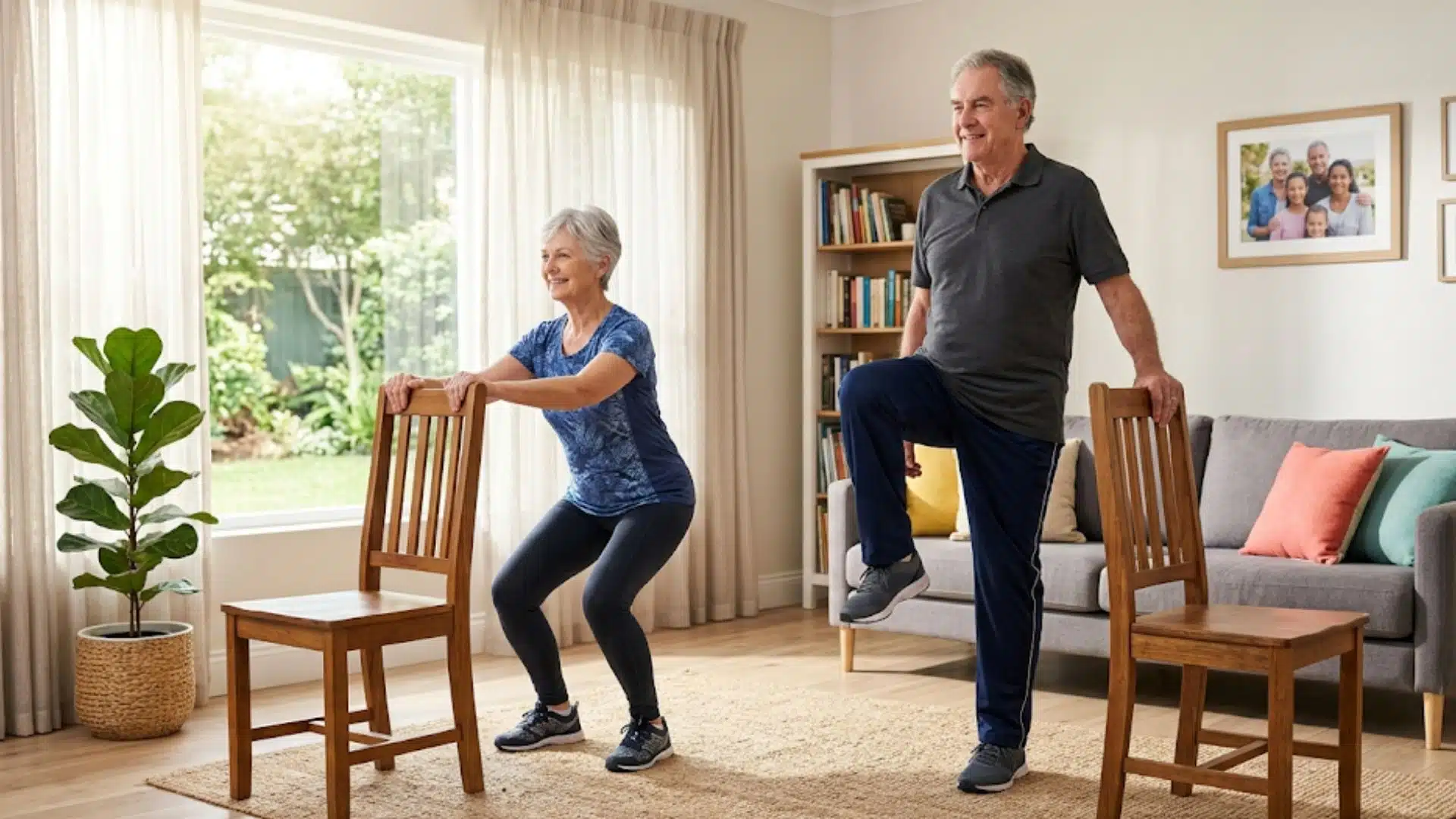
Easy Balance Exercises for Older Adults
If you have ever grabbed the doorframe on your way down the hall, or paused before stepping off a curb, you are in good company. Small changes in steadiness are common as the years go by — but here is the encouraging truth: balance is not a gift you either have or lose. It is a skill, and like any skill, it responds to practice.
These easy balance exercises are designed for real life. You do not need special equipment, a gym membership, or any experience. Every single move is done near something sturdy — a kitchen counter, a heavy chair, or a wall — so support is always within reach. And you start seated, which means even if you are nervous, you can begin today from the safety of your own chair.
After a couple of weeks of gentle practice, everyday things may start feeling easier: standing at the sink without leaning, turning to answer the door without wobbling. That quiet confidence on your feet is exactly what we are building toward.
Key Takeaways
- Balance is a trainable skill. Small, regular practice improves your steadiness more than occasional big efforts.
- Always exercise near sturdy support — a countertop, a heavy chair, or a wall — and keep your support within easy reach.
- If you feel dizzy, lightheaded, or unsteady at any point, stop right away and sit down. Never push through dizziness.
- Start with seated moves and work up gradually; there is no rush and no test to pass.
- Check with your doctor before starting any new exercise routine, especially if you have a health condition or take medications that affect balance.
- A few minutes a day is enough to see steady, encouraging progress.
Why Balance Matters More Than You Might Think
Balance quietly supports almost everything you do: reaching for a shelf, stepping into the shower, carrying a laundry basket, turning when someone calls your name. When balance is good, you hardly notice the effort. When it wavers, ordinary tasks can start feeling risky — and that uneasy feeling can slowly shrink your world.
That shrinking deserves attention. A small stumble shakes your confidence, shaken confidence leads to moving less, and moving less weakens the muscles that balance depends on. But the hopeful part is that this cycle also runs in reverse: a little steadiness builds a little confidence, which encourages a little more movement, which builds more steadiness.
Think of balance practice as maintenance for your independence. Your eyes, inner ear, leg muscles, and joints constantly work together to keep you upright, and gentle practice keeps that teamwork sharp. These are calm, ordinary movements done in an ordinary kitchen or living room — and they are genuinely enough to make a difference.
Set Up a Safe Spot Before You Start
Good balance practice begins before you move a muscle. Choose a spot with a clear floor — no sliding rugs, stray shoes, or cords underfoot. A kitchen counter is ideal: solid, waist-high, and long enough to walk beside. A heavy dining chair that does not wobble works too, or a bare wall with nothing to trip over at your feet.
Wear flat, supportive shoes with closed toes and non-slip soles, or go barefoot on a dry, non-slippery floor if that feels safer for you. Avoid socks on smooth floors. Keep a sturdy chair nearby even for the standing moves, so you can sit down the moment you want to rest. If you use a walker or cane, keep it within arm’s reach — it counts as support, and there is nothing wrong with using it.
One thing worth saying out loud: holding the counter is the whole point, not a sign of weakness. Support lets your body relax and learn, which is exactly how steadiness improves. Over time you may find yourself barely touching it — and that happens on its own, without forcing.
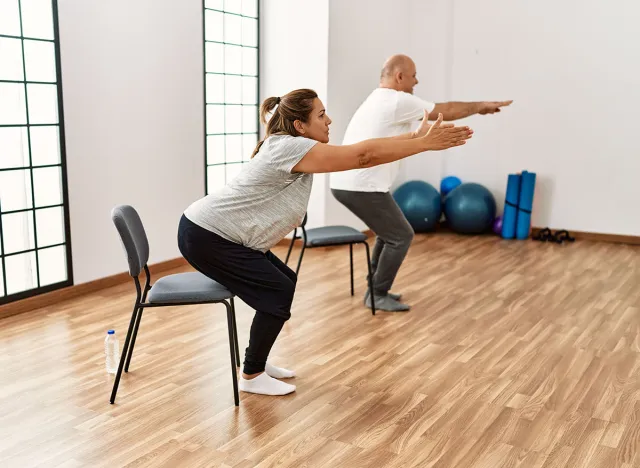
Six Gentle Balance Exercises, Easiest to Hardest
Work through these in order, staying at each level until it feels comfortable. Practice once a day, rest whenever you like, and keep one hand on or near your support for every standing move.
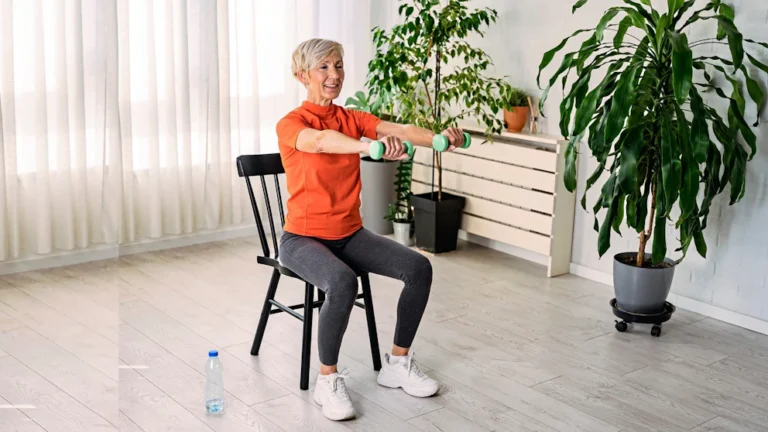
- Seated marching. Sit tall in a sturdy chair, feet flat on the floor, hands on your thighs or the chair arms. Slowly lift your right knee a few inches, lower it, then lift the left. Do 8–10 slow marches per side, keeping your breathing easy and your back straight. This wakes up your hip muscles and sense of rhythm — fully seated and supported. If you feel dizzy, stop and rest.
- Seated weight shifts. Stay in the same sturdy chair, feet flat and hip-width apart. Slowly lean your upper body right, feeling more weight press into your right foot, then return to center and lean left. Keep the movement small and controlled, like gentle rocking. Do 8–10 shifts per side. This builds the side-to-side control you use when changing direction while walking. Stop and rest if you feel dizzy.
- Standing weight shifts at the counter. Stand facing your kitchen counter, both hands resting on it, feet hip-width apart. Slowly shift your weight onto your right foot, lifting your left heel slightly, hold two seconds, then shift left. Repeat 8–10 times per side, keeping both hands on the counter the whole time. The counter steadies you while your ankles quietly do the learning. Sit down if you feel dizzy.
- Heel-to-toe standing near the counter. Stand beside your counter with one hand on it. Place one foot directly in front of the other, heel to toe, as if standing on a balance beam. Hold 10–20 seconds, breathing normally, then switch feet. If full heel-to-toe feels too much, place one foot just halfway in front — a narrower stance is already good practice. Keep your hand on the counter, and stop if you feel dizzy.
- Single-leg stand holding support. Stand facing the counter, both hands on it. Shift your weight onto one foot and lift the other just an inch or two off the floor. Hold 5–10 seconds, set it down, and switch sides. Keep your standing knee soft and look straight ahead, not at your feet. Two hands at first is fine; when 10 seconds feels easy, use just your fingertips. Stop and sit if you feel unsteady or dizzy.
- Tandem walking along a wall. Stand next to a wall, hand skimming along it, or beside the counter. Walk slowly forward, placing one foot directly in front of the other, heel to toe, like walking a tightrope at a snail’s pace. Take 8–10 steps, turn carefully with support, and walk back. Look forward, not at your feet, and keep your hand on the wall the whole time. This is the hardest move because you balance while moving — the skill that makes curbs and busy sidewalks feel less daunting. Sit down the moment you feel dizzy.
How the Exercises Compare
Here is a quick overview of all six moves. Aim to be comfortable at one level before trying the next — most people move on after a week or two of daily practice.
| Exercise | Difficulty | Support needed | What it trains |
|---|---|---|---|
| Seated marching | Very easy | Sturdy chair | Hip strength and movement rhythm |
| Seated weight shifts | Very easy | Sturdy chair | Side-to-side weight control |
| Standing weight shifts | Easy | Both hands on counter | Ankle steadiness and confidence standing |
| Heel-to-toe standing | Easy to moderate | One hand on counter | Narrow-stance balance and focus |
| Single-leg stand | Moderate | Hands or fingertips on counter | One-foot steadiness for stepping and stairs |
| Tandem walking | Moderate to challenging | Hand on wall or counter throughout | Balance while moving, like on curbs and sidewalks |

Frequently Asked Questions
What should I do if I feel dizzy during an exercise?
Stop immediately and sit down — that is the whole rule. Dizziness is your body asking for a pause, and there is no benefit in pushing through it. Sit until the feeling passes completely, and stick with the seated exercises for a while. If dizziness happens often or feels severe, talk to your doctor before continuing — it can relate to medications or inner-ear changes that deserve a professional look.
How often should I do these exercises?
About five to ten minutes, once a day, is a realistic and effective goal. A little daily practice builds balance far better than one long weekend session, because your nervous system learns through repetition. Many people pair it with something they already do — heel-to-toe standing while the kettle boils, or seated marches during a television program. Consistency matters far more than duration.
Can I do these exercises with my walker or cane nearby?
Absolutely. Keep your walker or cane within arm’s reach during every exercise, and use it freely as support during the standing moves if that feels better than the counter. Using a mobility aid is smart planning, not a sign these are beyond you. The seated moves are completely walker-friendly since you stay seated the whole time.
What if I can’t stand on one leg at all, even with support?
Skip the single-leg stand for now without a second thought. Stay with the two seated moves and the standing weight shifts for a few weeks — they build the exact muscles and coordination the single-leg stand needs. Many people surprise themselves after a month of steady practice. There is no deadline, and the easier moves are genuinely useful exercise on their own.
When will I start noticing a difference?
Most people notice a small improvement within two to three weeks of daily practice — standing taller at the sink, or turning around without that brief wobble. Bigger changes, like feeling sure-footed on uneven ground, tend to come after six to eight weeks. The progress is gradual, so notice and celebrate the small wins. A simple mark on the calendar for each day you practice makes the improvement easy to see.
Steady Feet, Steady Confidence
Remember where you started: balance is a skill, not a sentence. Every time you practice these easy balance exercises, you are teaching your body something it can genuinely keep. The support you hold onto today is not a crutch; it is a training partner, and it will quietly matter less and less as your steadiness grows.
Start small — perhaps the seated marches this evening, with your favorite program on in the background. Show up tomorrow, and the day after, and let the quiet accumulation of those small efforts do its work. Your feet have carried you this far in life. With a little daily practice, they will carry you with more confidence for a long time to come.