
How to Create Your First Weekly Workout Routine
You have decided to get fit, and that first decision is the hardest part. Now comes the question that stops most beginners in their tracks: what should you actually do each week? Scroll through fitness content online and you will find plans with twelve exercises per session and words you need a dictionary to understand.
Forget all of that for now. Building your first weekly workout routine does not require a gym membership, special equipment, or any prior experience. It requires one honest look at your calendar, a small handful of simple exercises, and a plan you can repeat week after week. In this guide, you will learn how to put that plan together step by step, and you will leave with a routine that actually fits your life instead of fighting it.
Key Takeaways
- Start with 2 to 4 workout days per week, not seven — rest days are where your body adapts and gets stronger.
- Pick exercises you can do with your own bodyweight so there are no barriers to getting started.
- Schedule your workouts like appointments; a plan written on a calendar is far more likely to happen.
- Cover the whole body across the week: legs, push muscles, pull muscles, and your core.
- Begin with short sessions of 20 to 30 minutes and increase length only when the routine feels easy.
- Track what you do each session so you can see your progress and keep motivation high.
- Expect some muscle soreness at first — it fades as your body adjusts, usually within two weeks.

Step 1: Decide How Many Days You Can Honestly Commit To
This is where most first routines fail. People build a six-day plan because it looks impressive, then quit by Thursday. Your weekly workout routine should start from your real life, not an imaginary version of it. Look at your actual week — work, family, chores — and count the days you can truly spare 20 to 30 minutes.
For most beginners, two to four days is the sweet spot. Two days builds the habit without overwhelming you. Three days gives you a full-body session with plenty of recovery between workouts. Four days lets you split things up a little more. Anything beyond that is unnecessary until the habit is solid, which usually takes four to six weeks.
Choose your days now and write them down. Morning person? Lock in three mornings. Evenings work better? Claim those evenings. The specific days matter far less than the commitment being realistic enough to survive a busy week.
Step 2: Pick One Simple Exercise for Each Major Movement
You do not need a long list of exercises. For your first routine, five or six movements that cover the whole body are more than enough. Here is a simple framework:
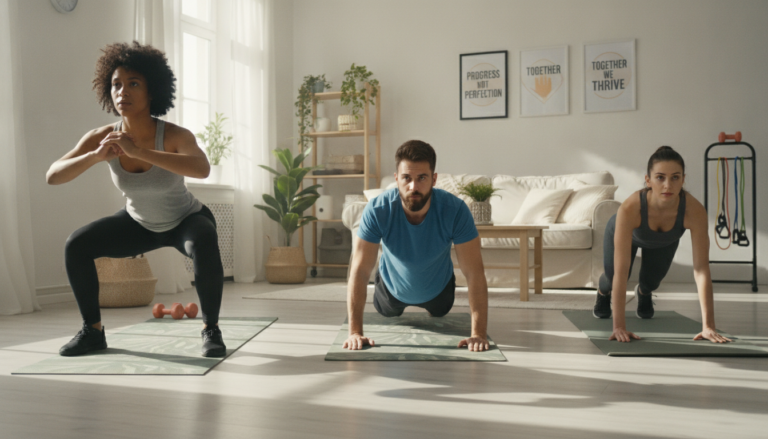
- Legs: bodyweight squats. Stand with feet shoulder-width apart, sit back like you are sitting in a chair, and stand back up.
- Push: knee push-ups or wall push-ups. Either one builds your chest, shoulders, and arms.
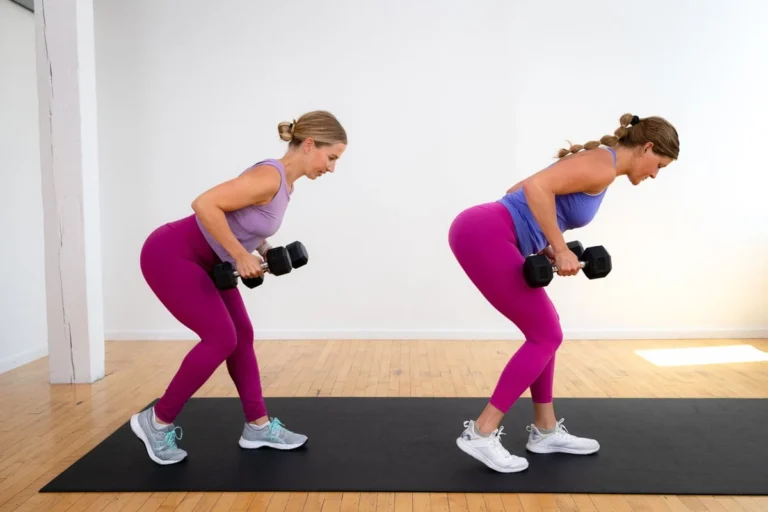
- Pull: bent-over rows using a backpack filled with books, or a sturdy table row if you can find a safe setup.
- Hips and back: glute bridges. Lie on your back with knees bent, feet flat, and lift your hips.
- Core: a basic plank, held for time rather than done in reps.
- Cardio finish: marching in place or jogging on the spot for two to three minutes.
Stick with these same exercises for your first three or four weeks. Repeating the same movements is how you learn proper form and notice yourself getting stronFrequentlyger. Variety can come later.
Step 3: Decide Your Sets and Reps
Once your exercises are chosen, you need a simple dose. A reliable starting point for beginners is two to three sets of eight to twelve repetitions per exercise. That means you do eight to twelve squats, rest for about a minute, and repeat. Do the same for each exercise, and hold the plank for 20 to 30 seconds per round instead of counting reps.
If you cannot reach eight reps with good form, that is completely fine — do as many clean reps as you can and stop when your form starts to break down. Quality always beats quantity at this stage. Sloppy reps teach bad habits and raise injury risk; clean, controlled movement builds the right pattern from day one.
As a rough guide, one full pass through all six movements at two sets each takes about 20 to 25 minutes. Add the cardio finish and you have a complete session in under half an hour.
Step 4: Spread Your Days Across the Week
Now slot your chosen days into a real calendar so rest days sit between workout days whenever possible. Recovery is not laziness — muscles repair and grow stronger on the days you are not training them. Back-to-back hard sessions as a beginner usually just create exhaustion and kill motivation.
The table below shows how a sample week looks for two, three, or four training days. Every option keeps the sessions short, spaces them out, and leaves room for life.
| Day | 2-Day Routine | 3-Day Routine | 4-Day Routine |
|---|---|---|---|
| Monday | Full body (30 min) | Full body (30 min) | Full body A (25 min) |
| Tuesday | Rest | Rest | Rest |
| Wednesday | Rest | Full body (30 min) | Full body B (25 min) |
| Thursday | Full body (30 min) | Rest | Rest |
| Friday | Rest | Full body (30 min) | Full body A (25 min) |
| Saturday | Rest | Rest | Rest |
| Sunday | Rest | Rest | Full body B (25 min) |
A quick note on the four-day version: “A” and “B” are simply two slightly different full-body sessions. For session B, swap squats for glute bridges as the main leg move, and swap push-ups for a second set of rows. This tiny change keeps things fresh while still training everything twice a week.
Step 5: Add a Five-Minute Warm-Up and Cool-Down
Skipping the warm-up is tempting when time is tight, but five easy minutes makes the workout feel dramatically better. March in place, swing your arms in big circles, do ten gentle squats, and rotate your ankles and wrists. You are simply raising your heart rate and loosening your joints before the real work starts.
When you finish, spend another few minutes cooling down rather than sitting straight down. Walk slowly around the room, take deep breaths, and gently stretch the muscles you just used — hold each stretch for about 20 seconds without bouncing. This small habit reduces next-day stiffness and gives you a calm moment to feel good about what you just did.
Step 6: Track Your Sessions in a Simple Log
Progress as a beginner is fast but invisible if you do not record it. You do not need a fancy system. A notebook page or a notes file on your phone works perfectly. After each session, write the date, the exercises, and what you did — for example, “Squats: 3 sets of 10” and “Plank: 25 seconds.”
Each week, try to beat one small number. One extra rep on your squats. Five more seconds on the plank. An extra set of push-ups. These tiny wins compound quickly, and on the days your motivation dips, your log is proof that you are genuinely improving.
Step 7: Plan for Missed Days Instead of Fearing Them
You will miss a workout eventually. Life happens — a sick child, a late shift, a day you just cannot face it. The difference between people who stick with fitness and people who quit is not perfection; it is what happens after the missed day. Quitters treat it as proof the plan failed; keepers treat it as one blank square on the calendar.
Make this your rule: never miss twice in a row. Missed Monday? Tuesday becomes a training day, no guilt and no “making up” with a double session. This single rule keeps one bad day from snowballing into a bad month, and it removes the all-or-nothing thinking that ruins so many first routines.

Frequently Asked Questions
How long should each workout session be?
Twenty to thirty minutes is plenty for the first month. Your body is adapting to brand-new demands, and short sessions let you practice good form without exhaustion. Once the routine feels easy — usually around week four or five — you can add a third set to each exercise or extend sessions to 35 or 40 minutes.
Do I need to work out every day to see results?
No. Beginners actually see faster progress with two to four sessions per week than with daily training, because recovery days are when your muscles rebuild stronger. Training every day as a beginner mostly leads to constant soreness and burnout. Consistency over months beats intensity over days, every time.
Is muscle soreness normal when starting out?
Yes, mild soreness for one to three days after your first few sessions is completely normal — it is called delayed-onset muscle soreness, and it fades as your body adapts, typically within two weeks. Sharp or joint pain is different and means you should stop that exercise and check your form. Gentle movement like walking actually eases normal soreness faster than total rest.
What if I can only do a few push-ups or squats?
That is exactly where everyone starts. Use easier versions: wall push-ups instead of floor push-ups, shallow squats instead of deep ones. The exercise still works the right muscles, and as you get stronger you graduate to the harder version. Your starting point does not matter nearly as much as the fact that you are starting.
When should I change my routine?
Keep your first routine for at least four to six weeks. When you can comfortably complete all your sets and reps with good form and the sessions feel easy, that is the signal to progress — add a set, add reps, try a harder exercise variation, or add a fourth training day. Change one thing at a time so you can tell what is working.
Your First Week Starts Today
Here is the beautiful secret about a weekly workout routine: it does not need to be perfect, it just needs to exist. Pick your days, choose your six simple exercises, and do your first 25-minute session this week. It will feel awkward. You will be a little sore. And you will have done something most people only talk about.
Then do it again next week, and the week after that. Somewhere around week four, you will notice the squats feel easier, the plank feels longer, and the habit feels like it belongs in your life. That is not luck — that is a routine doing exactly what routines do. Your future self is already grateful you started. Now go claim your first training day.